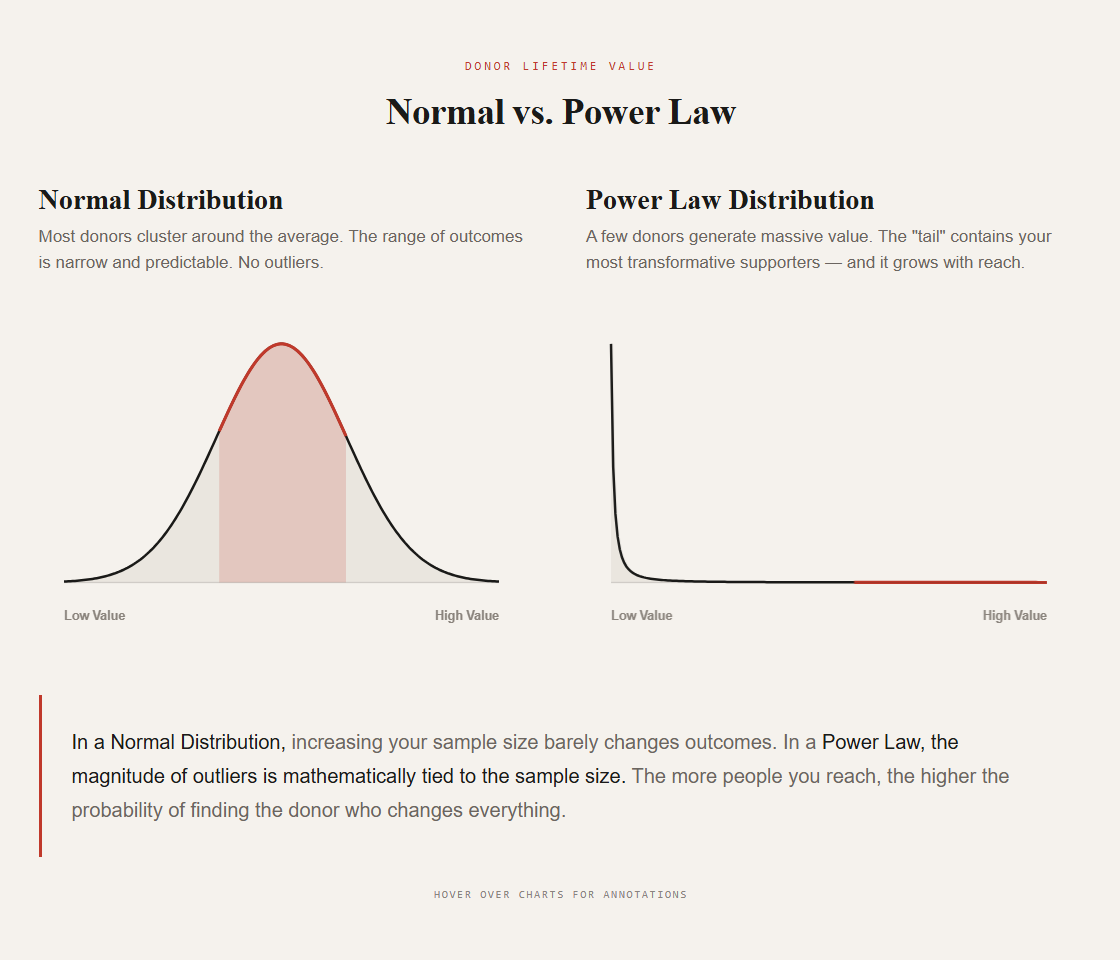
We are all taught to think in Bell Curves. In a Bell Curve world, most data points cluster around the average — the mean. Human height is a Normal Distribution: if you take the average height in a group, most people would be more or less that average, and you will never meet a man who is 100 feet tall.
But I have been analyzing charity donation records, and the most important KPI — Donor Lifetime Value — is always definitely closer to a Power Law. With some rare and interesting exceptions.
This has so many implications. I could write endlessly about this, but I'm sticking with one this time.
You can't retain a tail donor you never acquired. And you can't predict who becomes a tail donor from their first gift.
The retention advice that's dangerously incomplete
For years I have heard peers say "you don't have an acquisition problem, you have a retention problem." I think this advice is built on Bell Curve thinking. They're telling charities to optimize the middle — squeeze more from existing donors, reduce churn, and improve retention rates.
But if donor LTV follows a Power Law, the game isn't only about retaining average donors better. Specially for younger, smaller charities, the game is about finding more people who could become tail donors — and these are your monthly, loyal, or high-value folks.
And you can only find those people through acquisition. Through advertising. Through casting a wider net.
Most retention advice isn't wrong, but it's incomplete and dangerously misleading. Charities don't need to choose between acquisition and retention. But right now, the scale is tipped too far in one direction. It makes charities underinvest in the one thing that feeds the Power Law: having more people know about you and remember you.
The industry already admits this (halfway)
To be fair, the nonprofit sector intuitively understands the Power Law. We see it in how we structure our teams.
We hire Major Gift Officers. We build entire departments dedicated to the top 1–5% of the file. We accept that a donor who gives $100,000 requires a fundamentally different operational approach than a donor who gives $50. We don't send the $100K donor a window-envelope appeal; we take them to lunch.
We operationally accept the reality that 10–20% of the donors provide 80% of the revenue.
So we have accepted the Power Law in our staffing. But we completely ignore it in our budgeting.
The budgeting blind spot
When it comes to marketing budgets, most charities suddenly develop amnesia. They stop thinking in Power Laws and start thinking in Bell Curves again.
They look at Direct Mail and Email. They obsess over "average response rate," "average gift," and "average cost per acquisition." They pour the majority of their budget into these channels because they are efficient, predictable, and "safe."
They invest heavily in retaining the middle of the curve, but they chronically underinvest in Acquisition, Paid Media, and Out of Home.
This is a mathematical disaster. Here is why.
The math of discovery
In a Normal Distribution, increasing your sample size doesn't change the range of outcomes much. If you measure 100 people, the tallest might be 6'8". If you measure 10,000 people, the tallest might be 7'2". The ceiling is hard.
But in a Power Law, the magnitude of the outliers is mathematically tied to the sample size.
The more people you reach, the higher the probability of finding a "Black Swan" — that one donor who changes the trajectory of your entire organization.
Direct Mail and Email is a closed loop. You are fishing in a small pond. You are optimizing for efficiency, but you have capped your discovery potential. Paid Media and OOH is the open ocean. By drastically increasing your reach, you are not just getting "more volume" — you are statistically increasing the likelihood of capturing an extreme outlier.
Efficiency vs. magnitude
The problem is that Paid Media looks "inefficient" on a spreadsheet compared to Direct Mail. The CPA is higher. The initial retention is lower.
But this view is shortsighted. It assumes that every new donor is an "average" donor.
If you believe in the Power Law, you don't care about the efficiency of the average. You care about the probability of the extreme.
When you starve acquisition to feed direct mail, you are making a choice. You are choosing to be efficient at being small, rather than accepting the volatility required to become massive.
Stop optimizing for the average. The average donor doesn't move the needle. Hunt for the tail.
The strategic shift
We need to align our budgets with our staffing.
We already know that the "Head" of the curve drives the mission. We have the Major Gift Officers ready to steward them. But we are starving the engine that finds them.
It is time to stop viewing Paid Media and Mass Awareness as "wasteful" spend that diverts money from the program. In a Power Law world, broad acquisition is the R&D cost of finding the donors who make the program possible.
In a Power Law — or Pareto — distribution, the "average" doesn't actually exist in a meaningful way. The tail is long, and the head is massive. A tiny percentage of events accounts for the vast majority of the impact.
Stop optimizing for the average. The average donor doesn't move the needle.
Hunt for the tail.